

Business
Delving into Sage's 2022 Report on the untapped tech adoption that could boost the UK economy by £232 billion annually. .


Tomislav Simnett
4 min read
In a rapidly evolving business landscape, technology has become the driving force behind innovation and growth. Small and medium-sized businesses (SMBs) in the United Kingdom are no exception to this trend. The year 2022 marked a significant turning point, as Sage, a leading provider of business software and solutions, released a comprehensive report on UK SMB technology adoption. The report offers valuable insights into how technology can be a catalyst for growth among these enterprises. In this blog post, we will delve into the key findings from the Sage report and discuss how UK SMBs can harness the power of technology to unlock their potential and flourish.
Understanding the Landscape
The Sage report paints a vivid picture of the technology adoption landscape among UK SMBs in 2022. It highlights the fact that many of these businesses have recognised the importance of technology but still face various challenges. Let's explore the key findings:
- Digital Transformation: Approximately 60% of UK SMBs have embarked on their digital transformation journey. However, a substantial number are still in the early stages, and there is significant room for growth.
- Cloud Adoption: Cloud technology adoption has seen substantial growth, with more than 70% of SMBs relying on cloud-based services. This shift has improved flexibility, scalability, and collaboration for these businesses.
- Cybersecurity Concerns: Despite the increasing reliance on technology, cybersecurity remains a significant concern for SMBs, with nearly 40% lacking confidence in their cybersecurity measures.
- Data Analytics: Around 55% of SMBs use data analytics to make informed decisions. However, there is room for improvement in utilising data to its full potential for strategic insights.
How SMBs Can Grow Through Technology Investments
- Embrace Digital Transformation: The path to growth begins with embracing digital transformation. As seen in the report, SMBs that have taken steps in this direction are reaping the rewards. By digitising processes, streamlining operations, and enhancing customer experiences, businesses can become more agile and efficient.
- Leverage Cloud Technology: Cloud adoption provides SMBs with the ability to scale their operations as needed, reducing upfront capital expenses and enhancing mobility. Invest in cloud solutions for better collaboration, data accessibility, and flexibility.
- Prioritise Cybersecurity: The report highlights that SMBs need to strengthen their cybersecurity posture. By investing in robust security measures, businesses can protect their valuable data, build trust with customers, and avoid costly data breaches.
- Harness Data Analytics: Data is a goldmine waiting to be tapped. SMBs can harness data analytics to gain valuable insights into customer behaviour, market trends, and operational efficiency. This can inform strategic decisions and improve overall performance.
- Stay Informed and Adapt: The technology landscape is constantly evolving. Staying informed about emerging trends and being willing to adapt to new technologies is crucial for long-term success. SMBs should allocate resources for ongoing education and technology updates.
The Sage report on UK SMB technology adoption in 2022 serves as a valuable guide for small and medium-sized businesses looking to thrive in an increasingly digital world. By embracing digital transformation, leveraging cloud technology, prioritising cybersecurity, harnessing data analytics, and staying informed, SMBs can position themselves for growth and success.
Technology investments are not merely expenses; they are investments in the future of your business. With the right strategies in place, UK SMBs can unlock their potential and seize the opportunities presented by the ever-evolving tech landscape. The time to invest in technology is now, and the rewards are waiting for those who take the leap.
But why are UK SMB behind in adopting technology solutions....?
The top barriers for investment are cost and understanding:
- The most significant barrier is cost, with 41% concerned about adopting new tech due to cash flow pressure and 24% unsure of the return on investment
- Second is awareness, with 34% stating they are unaware of which solution is right for them
- Almost a third (30%) say that training staff on new processes and breaking habits are also a barrier
SMBs must prioritise investment in digital tools to successfully mitigate against macroeconomic challenges
- The threat of a recession, continued inflation and increased costs are [significantly] impacting SMBs
- Over 9 in 10 businesses (92%) state that technology is important to their survival and growth, and 88% say that it is key to business resilience
Data is an important area of untapped potential
- Technology that generates data (websites, social media, accountancy, and HR software) have been widely adopted by small and medium-sized business – and continue to see high levels of investment
- However, only 24% of SMBs have adopted tech to collect and use data, such as data analytics software
- Five sectors with the lowest adoption of data analytics technology are beauty and wellbeing, retail, creative industries, hospitality, and education
The pandemic prompted a fundamental perception shift across SMBs regarding digital technology
- 92% say that digital tools have been vital to their survival through the pandemic
- Of businesses founded in the past two years, 91% credited their creation to new and innovative technologies
- 8 in 10 SMBs say that technology is important to achieving their business goals. This is reflective of every sector and region in the UK
- Over 75% of businesses stated that online reputation information, such as online reviews and ratings (‘Blue Tick Tech’) is important to them
For the full findings - See Sage Report: Digital Britain: How Small Businesses are turning the tide on tech
With this in mind, Initforthe is here to help - we understand and recognise the concerns but more importantly, we're experts in helping you mitigate these risks and reap the rewards of investing in technology for your business. Rather than adding costly third-party software to your business we create bespoke solutions that work for your business enabling you to grow quicker and with no messy workarounds from using software built for the masses.
Businesses that have worked with us have seen significantly improved productivity from their workforce, a reduction in operating costs as well as increased revenue and profits.
We offer free no-obligation consults - get in touch today. We're Initforthe future with you.
With this in mind, Initforthe is here to help - we understand and recognise the concerns but more importantly, we're experts in helping you mitigate these risks and reap the rewards of investing in technology for your business. Rather than adding costly third-party software to your business we create bespoke solutions that work for your business enabling you to grow quicker and with no messy workarounds from using software built for the masses.
Businesses that have worked with us have seen significantly improved productivity from their workforce, a reduction in operating costs as well as increased revenue and profits.
We offer free no-obligation consults - get in touch today. We're Initforthe future with you.
How much capacity is your business leaving behind?
Use the calculator to estimate what slow processes, manual work and disconnected systems could really be costing you.
More posts.
View all
Business
Your Software Holds the Data. But Does It Know How Your Business Works?
Your software might hold all the data about your business, but does it actually know how your business works? In two recent conversations, I challenged business leaders to question something they'd always taken for granted: whether the work their people were doing needed a person to do it at all.
From unnecessary CRM administration to an entire department dependent on one employee's knowledge, both conversations revealed opportunities that went far beyond making existing tasks easier. What if our systems could understand how work happens, learn from our best people and eventually take responsibility for much of the routine work themselves?
Tomislav Simnett
8 min read
Tech
AI can write the code. Your business still needs an engineer
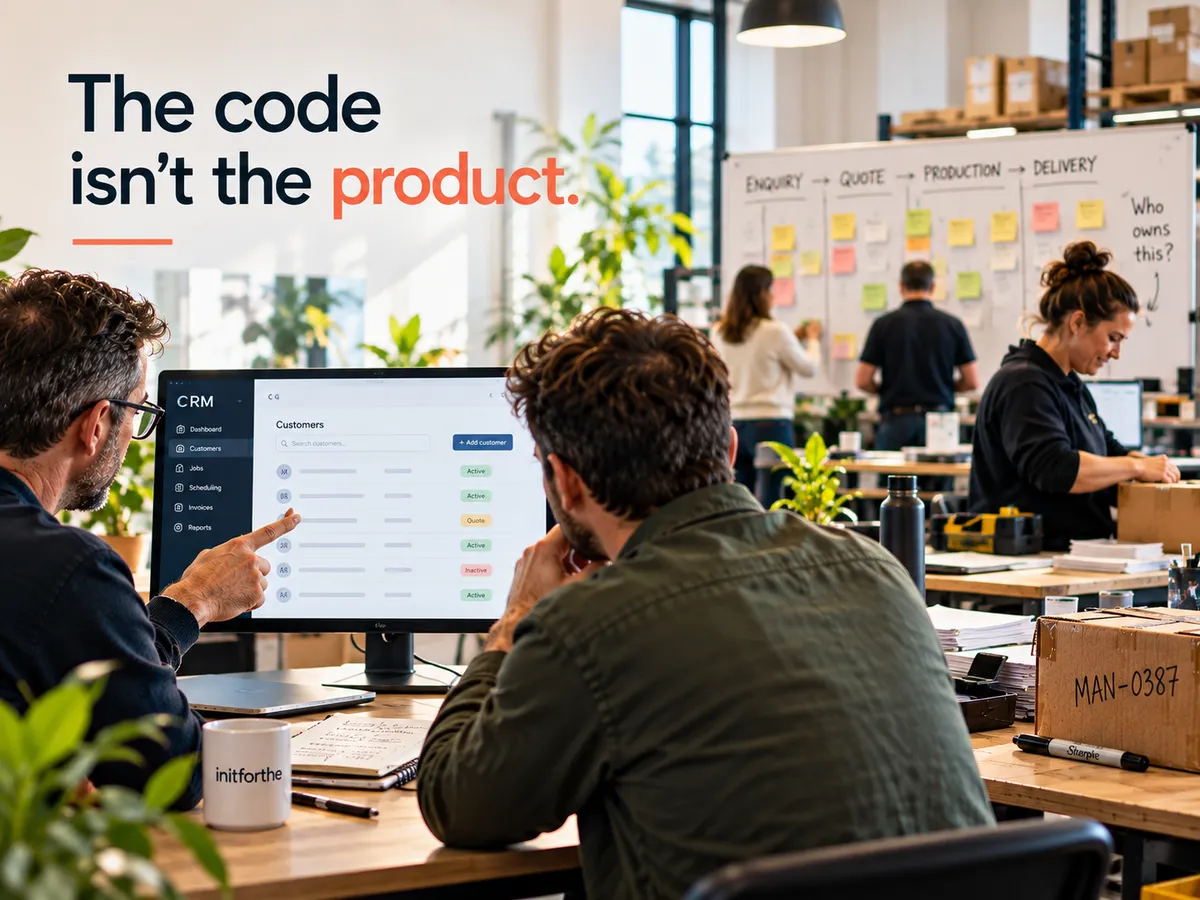
AI can now write a lot of the code we used to pay developers to write. That doesn’t make software engineering irrelevant. It makes the bit that was always more important much harder to ignore: understanding what should be built in the first place.
Vibe coding can turn your assumptions into working software incredibly quickly. But if the assumption is wrong, you’ve simply built the wrong thing faster. Good engineering starts before the app, CRM or automation. It starts by understanding how the business actually works, where people add judgement, and which parts of the process shouldn’t exist at all.
Tomislav Simnett
11 min read

Business
Four interruptions, two lost hours and the process your people shouldn’t be driving
Four interruptions can wipe nearly two hours from the useful part of a working day, and that’s before you count the interruption itself. Add long manual processes, routine human error, rework and stress, and you get a working environment where good people spend too much time recovering, correcting and chasing.
The answer isn’t to tell people to focus harder. It’s to design a better system, one that drives the process, preserves context, moves routine work automatically and only interrupts people when their judgement is genuinely needed.
Tomislav Simnett
10 min read