

Reference
One size doesn't fit all.
Off the shelf software doesn't work for every business


Tomislav Simnett
2 min read
In our last blog, we dared to suggest that the customer isn't always right.
Yet we survived to talk some more!
During that particular post, we listed 13 steps that the developers at initforthe go through, to help customers work out exactly what it is they really need. Notice I didn't say want!
We also help our customers to understand what is involved in getting them from where they are now to where they want to be.
When looking at implementing business software systems, many companies fail to ask those all too crucial questions first:
-- Who are my stakeholders, my influencers, my customers and my deliverers?
-- What exactly am I trying to achieve?
-- What is being moved – data? product? people? – and many more steps…
-- What / who are my priorities?
-- What are my 'vital-to-have', 'must-have' and 'nice-to-have' features?
-- How much time investment is needed in the user experience (particularly for external facing issues).
-- What are the implications of NOT including something?
It is very rare to find a person who has already asked themselves all these questions. Someone who has the perfect plan, written down on paper, for us to be able to work to.
Many of them go down the basic 'off-the-shelf software route. But when off-the-shelf software is bought:
-- Internal business processes often get changed to fit the software, instead of the other way around
-- Vast sums of money can be spent on customising the application to the needs of the business cost of the licenses for a standard product most likely won't be a lot different to a bespoke solution
-- People just don't use it properly because it isn't the same as they're used to. You know how we all love change!!
-- The ROI is nowhere near as good as it could be
Every company's needs are absolutely unique - even those in the same industry. By investing in a bespoke software solution, you will become the owner of a fully scalable system that:
-- Does exactly what you need, when you need it
-- Already includes a review of what you currently do and what could be improved upon
-- Will have the buy-in from your team, since they will have most likely had input during the development phase; and understand the changes they need to make to ensure it's success
-- Will deliver the ROI you are looking for!
Still looking at something off the shelf?
How much capacity is your business leaving behind?
Use the calculator to estimate what slow processes, manual work and disconnected systems could really be costing you.
More posts.
View all
Business
Your Software Holds the Data. But Does It Know How Your Business Works?
Your software might hold all the data about your business, but does it actually know how your business works? In two recent conversations, I challenged business leaders to question something they'd always taken for granted: whether the work their people were doing needed a person to do it at all.
From unnecessary CRM administration to an entire department dependent on one employee's knowledge, both conversations revealed opportunities that went far beyond making existing tasks easier. What if our systems could understand how work happens, learn from our best people and eventually take responsibility for much of the routine work themselves?
Tomislav Simnett
8 min read
Tech
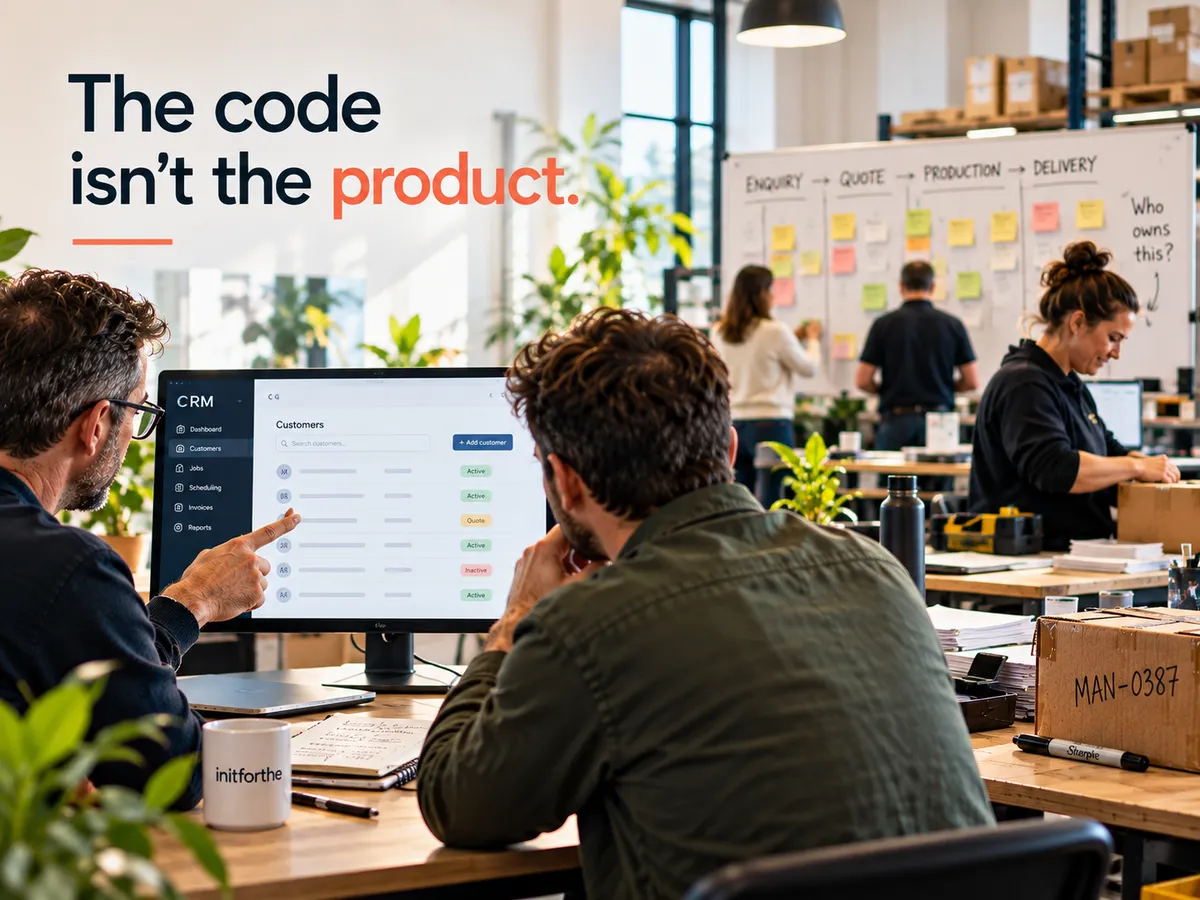
AI can write the code. Your business still needs an engineer
AI can now write a lot of the code we used to pay developers to write. That doesn’t make software engineering irrelevant. It makes the bit that was always more important much harder to ignore: understanding what should be built in the first place.
Vibe coding can turn your assumptions into working software incredibly quickly. But if the assumption is wrong, you’ve simply built the wrong thing faster. Good engineering starts before the app, CRM or automation. It starts by understanding how the business actually works, where people add judgement, and which parts of the process shouldn’t exist at all.
Tomislav Simnett
11 min read

Business
Four interruptions, two lost hours and the process your people shouldn’t be driving
Four interruptions can wipe nearly two hours from the useful part of a working day, and that’s before you count the interruption itself. Add long manual processes, routine human error, rework and stress, and you get a working environment where good people spend too much time recovering, correcting and chasing.
The answer isn’t to tell people to focus harder. It’s to design a better system, one that drives the process, preserves context, moves routine work automatically and only interrupts people when their judgement is genuinely needed.
Tomislav Simnett
10 min read