

Business
The importance of the business case on digital projects.
The importance of a business case


Tomislav Simnett
3 min read
We're back with another article highlighting an important aspect of any digital project. This time, it is one that should happen before any work is actually undertaken on the project itself.
A business case is fairly straight forward. It is the primary business motivation behind performing some task or developing some project past an idea phase. In fact, usually, the business case is developed before a project is identified to enable that business case to be realised.
So what does a business case look like?
It can be a one-liner; "we want to sell Y volume of product X in Z timeframe". It could also be a bigger document describing some specific business function that needs to happen, but it won't ever go into specific detail as to how the business case is to be achieved. For most businesses looking to use digital means of marketing, it'll be things like brand awareness increase, increased Facebook reach, sales volume, and anything else that can be measured in some way. The business case will usually also include information regarding the demographic to be targeted.
What a business case looks like for us
We're often given projects to build this or that on Facebook or some other platform, and we're rarely given the business case for the project. We're usually quite happy to build them, but when presented a business case we can usually offer best practice advice as to what does and doesn't work in particular areas, and how best to reach a specific target audience, which in turn will help to shape the overall project.
We've recently been engaged by an agency to tackle an age-old problem. A brand wants to enter the deep, dark world of social media but doesn't know where to start. That doesn't particularly worry me, as most businesses new to a means of marketing are usually unaware of what kind of results could potentially be achieved. Typically though, they'll want to start growing their reach (the number of people who can hear, or see, their communication). That's a good a start as any, but why does it matter?
Well, the original brief meant that this brand (we're under NDA, so I can't tell you which) would have instantly alienated half their target audience, so we had to find a way to deliver back some mechanism by which to engage the 50% or so that don't have an iOS device.
We boiled down the options, still wanting to keep the entry point as Facebook as an opening social media gambit, and settled on a competition whose details could be found on the brand's new Facebook page, along with an entry mechanism, but also allowed instant gratification and entry via mobile messaging. Send a picture to a shortcode number, and you're entered into the competition, subject to the rules, which are on Facebook. All aspects of the entry lead the user to either a Facebook or mobile page with share options so users are encouraged to share further to increase the chances they are involved in the prize pool.
Why the business case mattered
Without the business case though, we would have been completely unable to advise as to why the initial option that was tabled wouldn't perform adequately and would have ended up putting the end client off further social media work, despite their brand being able to take a huge advantage by using it well.
We always question the business case, and we work hard to ensure that what we deliver is more than just an app and stems from real business insight.
Our team offers Coaching and support throughout your digital journey, get in touch with the team at Initforthe to learn more.
How much capacity is your business leaving behind?
Use the calculator to estimate what slow processes, manual work and disconnected systems could really be costing you.
More posts.
View all
Business
Your Software Holds the Data. But Does It Know How Your Business Works?
Your software might hold all the data about your business, but does it actually know how your business works? In two recent conversations, I challenged business leaders to question something they'd always taken for granted: whether the work their people were doing needed a person to do it at all.
From unnecessary CRM administration to an entire department dependent on one employee's knowledge, both conversations revealed opportunities that went far beyond making existing tasks easier. What if our systems could understand how work happens, learn from our best people and eventually take responsibility for much of the routine work themselves?
Tomislav Simnett
8 min read
Tech
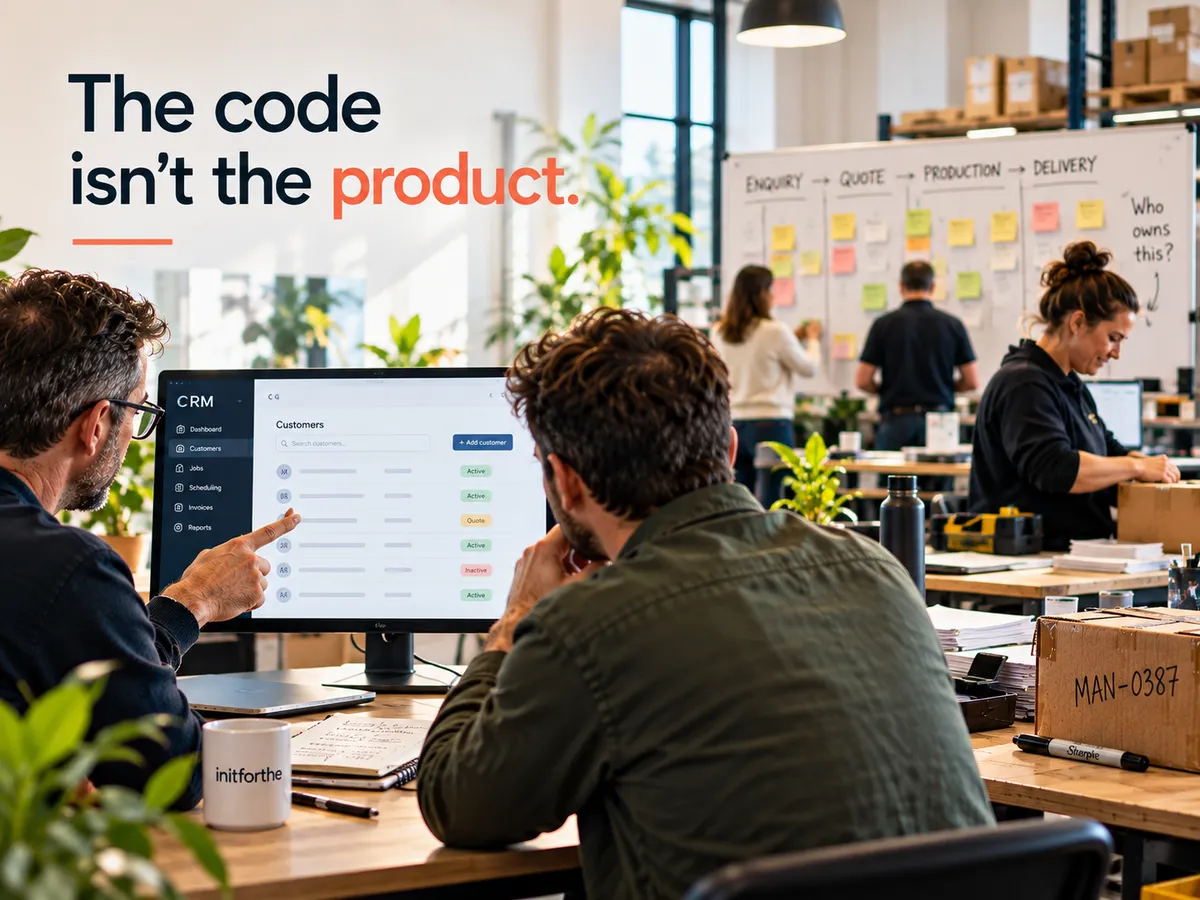
AI can write the code. Your business still needs an engineer
AI can now write a lot of the code we used to pay developers to write. That doesn’t make software engineering irrelevant. It makes the bit that was always more important much harder to ignore: understanding what should be built in the first place.
Vibe coding can turn your assumptions into working software incredibly quickly. But if the assumption is wrong, you’ve simply built the wrong thing faster. Good engineering starts before the app, CRM or automation. It starts by understanding how the business actually works, where people add judgement, and which parts of the process shouldn’t exist at all.
Tomislav Simnett
11 min read

Business
Four interruptions, two lost hours and the process your people shouldn’t be driving
Four interruptions can wipe nearly two hours from the useful part of a working day, and that’s before you count the interruption itself. Add long manual processes, routine human error, rework and stress, and you get a working environment where good people spend too much time recovering, correcting and chasing.
The answer isn’t to tell people to focus harder. It’s to design a better system, one that drives the process, preserves context, moves routine work automatically and only interrupts people when their judgement is genuinely needed.
Tomislav Simnett
10 min read