

Business
X Marks the spot: Without a map for your business, you're lost..


Tomislav Simnett
3 min read
When we go and see clients for the first time, we spend a lot of time understanding the detail about what the people in the business to in order to get their job done. Sometimes business owners will want to skip the step of documenting those processes because "we know what we do".
Let's take the perspective of a new member of staff, and let's give her a name: Jenny. As a business owner, you want Jenny to get to grips with her role in the organisation as quickly as possible, and in your mind, that's fairly straight forward. But you've been doing it for years. Jenny on the other hand has never seen your business before, and as it turns out there are lots of if's and but's in your processes.
It's the same thing if you want to end up with a successful software project. The best software does as much as possible for you, so it's important to map out the parts of the business you're trying to automate.
How do you go about mapping your business?
This is a fairly exhausting exercise for most business people because they've never done it before and it requires some deep thinking about the way things are done. But the rewards are huge - you will uncover all sorts of areas where you plaster over the cracks, but most importantly, everyone will know what to do at each step of the business journey, and so your consistency will improve.
It also helps to uncover complexity in your processes. Sometimes it's there for a reason and other times it's just the way it's always been done. By uncovering these areas, you'll be able to more easily identify the parts of the business that you can gain the most value from when it comes to automation - typically, you want to start with smaller, simpler processes that have a big impact. By mapping your business out, you can see these clearly.
How to start mapping out your business
Even better, you'll need to document your processes if you want to go for any of the ISO standard certifications - 9001 in particular, but also 27001. If you don't know what these are, ISO9001 is a standard for quality management, and means a business delivers a consistent level of quality which is tracked and measured. ISO27001 is a security standard and proves (amongst other things) that you have secure processes for storing and managing data as it flows through the business. They're often marked as an achievement target by businesses because they can often open doors up to much larger contracts than would otherwise be attainable by the business.
If you want some tools to help you along the way, Lucidchart provides all the shapes you need to get started, but it's worth reading up a bit on how to map processes if this is all new to you.
I'll be honest though - documenting your whole business top to bottom is a daunting and likely thankless task until you want those ISO standards. You're better off looking at areas you have a gut sense can be improved and document those to make the whole lot a bit more visual for you. That way, you can look down on it and see where there are gaps, or sections can be removed or moved around a bit to make the flow a little less complex.
Next steps...
Armed with a map, the next step is to work out what parts of the process can or should be automated, and that's where the beauty of the map really lies - the map is just a guide, but the real treasure can be found through always looking for the next better way to do something.
To discover how initforthe can improve your businesses productivity, get in touch today for a consultation.
How much capacity is your business leaving behind?
Use the calculator to estimate what slow processes, manual work and disconnected systems could really be costing you.
More posts.
View all
Business
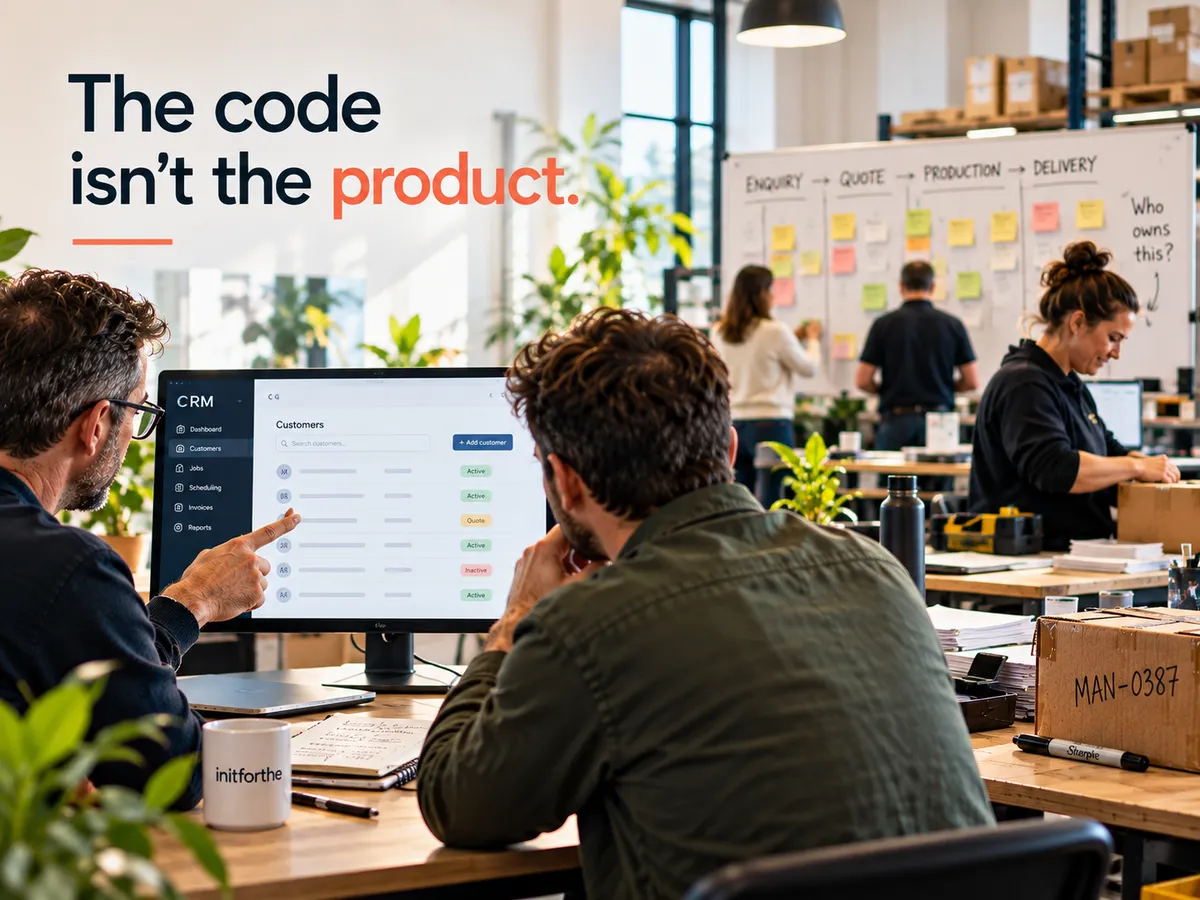
Your Software Holds the Data. But Does It Know How Your Business Works?
Your software might hold all the data about your business, but does it actually know how your business works? In two recent conversations, I challenged business leaders to question something they'd always taken for granted: whether the work their people were doing needed a person to do it at all.
From unnecessary CRM administration to an entire department dependent on one employee's knowledge, both conversations revealed opportunities that went far beyond making existing tasks easier. What if our systems could understand how work happens, learn from our best people and eventually take responsibility for much of the routine work themselves?
Tomislav Simnett
8 min read
Tech
AI can write the code. Your business still needs an engineer
AI can now write a lot of the code we used to pay developers to write. That doesn’t make software engineering irrelevant. It makes the bit that was always more important much harder to ignore: understanding what should be built in the first place.
Vibe coding can turn your assumptions into working software incredibly quickly. But if the assumption is wrong, you’ve simply built the wrong thing faster. Good engineering starts before the app, CRM or automation. It starts by understanding how the business actually works, where people add judgement, and which parts of the process shouldn’t exist at all.
Tomislav Simnett
11 min read
Business
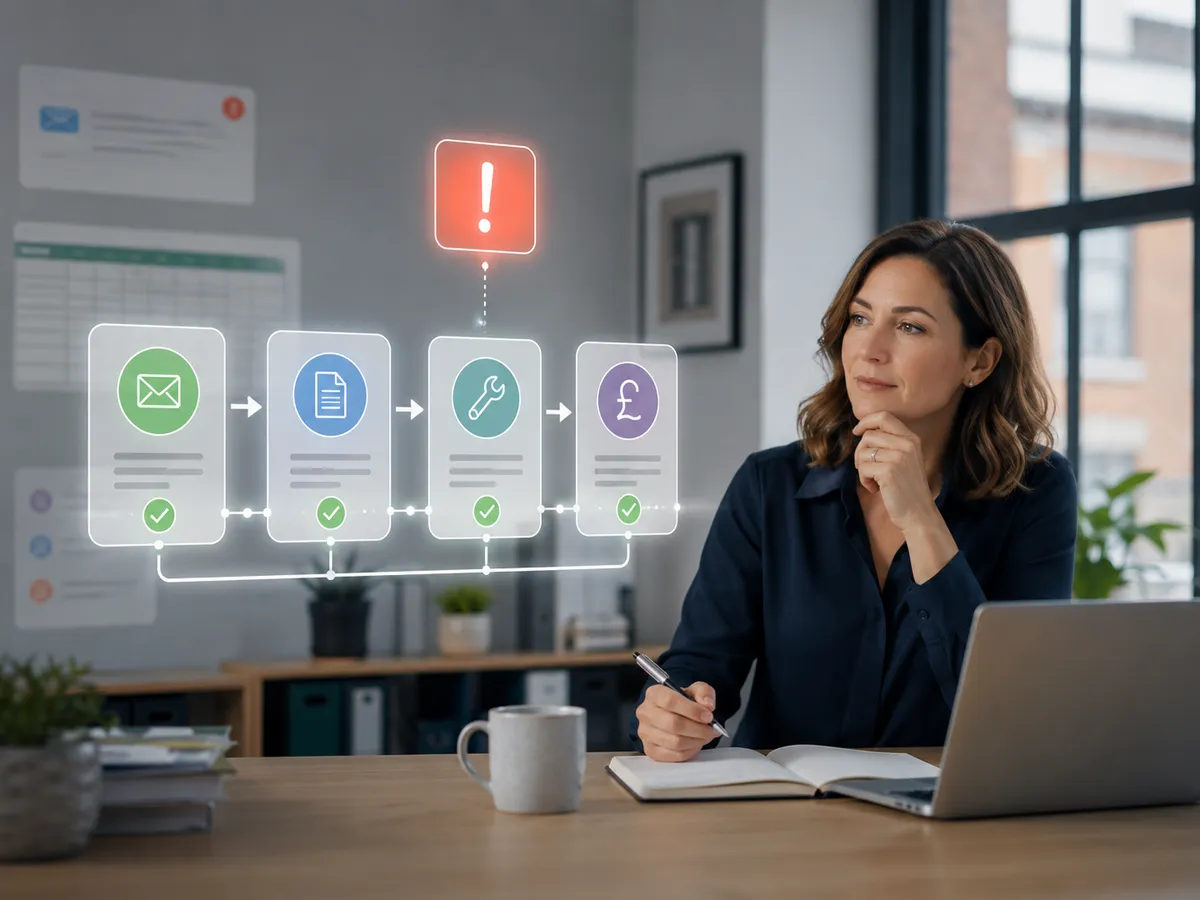
Four interruptions, two lost hours and the process your people shouldn’t be driving
Four interruptions can wipe nearly two hours from the useful part of a working day, and that’s before you count the interruption itself. Add long manual processes, routine human error, rework and stress, and you get a working environment where good people spend too much time recovering, correcting and chasing.
The answer isn’t to tell people to focus harder. It’s to design a better system, one that drives the process, preserves context, moves routine work automatically and only interrupts people when their judgement is genuinely needed.
Tomislav Simnett
10 min read