

Business
Don't Believe The Hype - The Ugly Truth About Using Third-Party Software to Scale Your Business.


Tomislav Simnett
3 min read
If you're a small business owner looking to scale your operations you've probably encountered countless ads and articles promoting the use of third-party software. They promise to streamline your processes, boost efficiency, and ultimately, help you achieve rapid growth. While it can be tempting to jump on the bandwagon it's important to take a step back and consider the potential drawbacks. In this blog post, we'll shine a light on the ugly truth about using third-party software to scale your business and provide you with some alternative strategies to achieve sustainable growth. So, grab a cup of coffee and get ready for some real talk!
Don't Believe the Hype: Here's Why Custom Solutions Are Key
While third-party software may seem like an attractive option for scaling your business, it is important to consider the drawbacks and limitations that come with it. Instead of falling for the hype, investing in custom solutions can offer numerous benefits and ensure sustainable growth for your business. Here's why we believe custom solutions are key and most importantly why they typically can cost less, not more than third-party software solutions...
Scalability and Adaptability
Custom solutions are designed specifically to meet the unique needs and requirements of your business. Unlike third-party software that may not be able to accommodate your evolving needs as your business grows, custom solutions can be tailored to scale alongside your operations. Whether it's adding new features, integrating with existing systems, or accommodating increased user load, custom solutions can be easily adapted to support your business growth.
Full Control and Flexibility
With custom solutions, you have complete control over the design, functionality, and workflows of the software. You can align the solution precisely with your business processes, rather than having to adapt your operations to fit predefined features. This level of control allows you to optimise and streamline your operations according to your specific requirements, resulting in increased efficiency and productivity.
Enhanced Data Security and Privacy
With your own in-house system, you have full control over the security measures implemented in your software. You can prioritise data security and privacy according to your business requirements, ensuring that sensitive information is protected from unauthorised access or breaches. By partnering with our award-winning, experienced developers, you can implement robust security features and keep your data safe.
Seamless Integration
Integrating third-party software with your existing systems can be a complex and time-consuming process, often leading to compatibility issues and operational inefficiencies. Custom solutions, on the other hand, can be seamlessly integrated with your current infrastructure, ensuring smooth data flow and compatibility. This eliminates any disruptions or delays caused by integration challenges, allowing your business to operate seamlessly.
Increased Productivity and Efficiency
Building your own software allows you to optimise and streamline your operations according to your business processes. You can eliminate unnecessary features or workflows that do not align with your requirements, resulting in increased productivity and efficiency. By customising the software to fit your workflows precisely, you can save time, reduce manual errors, and automate repetitive tasks.
Long-Term Cost Savings
While third-party software often comes with recurring subscription fees, custom solutions offer long-term cost savings. By investing in a solution that is tailored to your business, you eliminate the need for ongoing licensing fees and reduce reliance on external support. Additionally, our custom solutions are built to scale efficiently, avoiding the need for costly upgrades or migrations in the future.
Competitive Edge and Unique Differentiation
By investing in your own software, you can gain a competitive edge and differentiate your business from competitors. By offering unique functionalities, better user experiences, and more efficient processes, you position your business as a leader in your industry. Customers are more likely to choose a business that provides tailored solutions that cater to their specific needs.
So yes, whilst investing in custom solutions will require upfront costs and development time, our customers have often found that the benefits and cost savings very quickly outweigh the initial investment and they can significantly contribute to your business's growth and success. By choosing custom solutions over third-party software, you can ensure that your business has the flexibility, scalability, and control it needs to thrive in today's competitive landscape.
Read our case study here and see how our work allowed our client Train Aid to grow their turnover by 15 times compared to when they started working with us, with minimal new hires....
"Tom took the time in the initial consultation stage to really get to know our business. A clear strategy was proposed with specific deadlines for the different stages and ongoing opportunities for us to give our own feedback. We felt really involved in the whole process."
Tom Casserley, Managing Director, Train Aid
In our next couple of blogs, we'll dive deeper into how UK businesses can utilise R&D tax credits to offset the investment of developing custom solutions and further explore the steps involved in creating a tailored software solution for your business. Stay tuned to learn how you can leverage custom solutions from Initforthe to scale your business effectively.
How much capacity is your business leaving behind?
Use the calculator to estimate what slow processes, manual work and disconnected systems could really be costing you.
More posts.
View all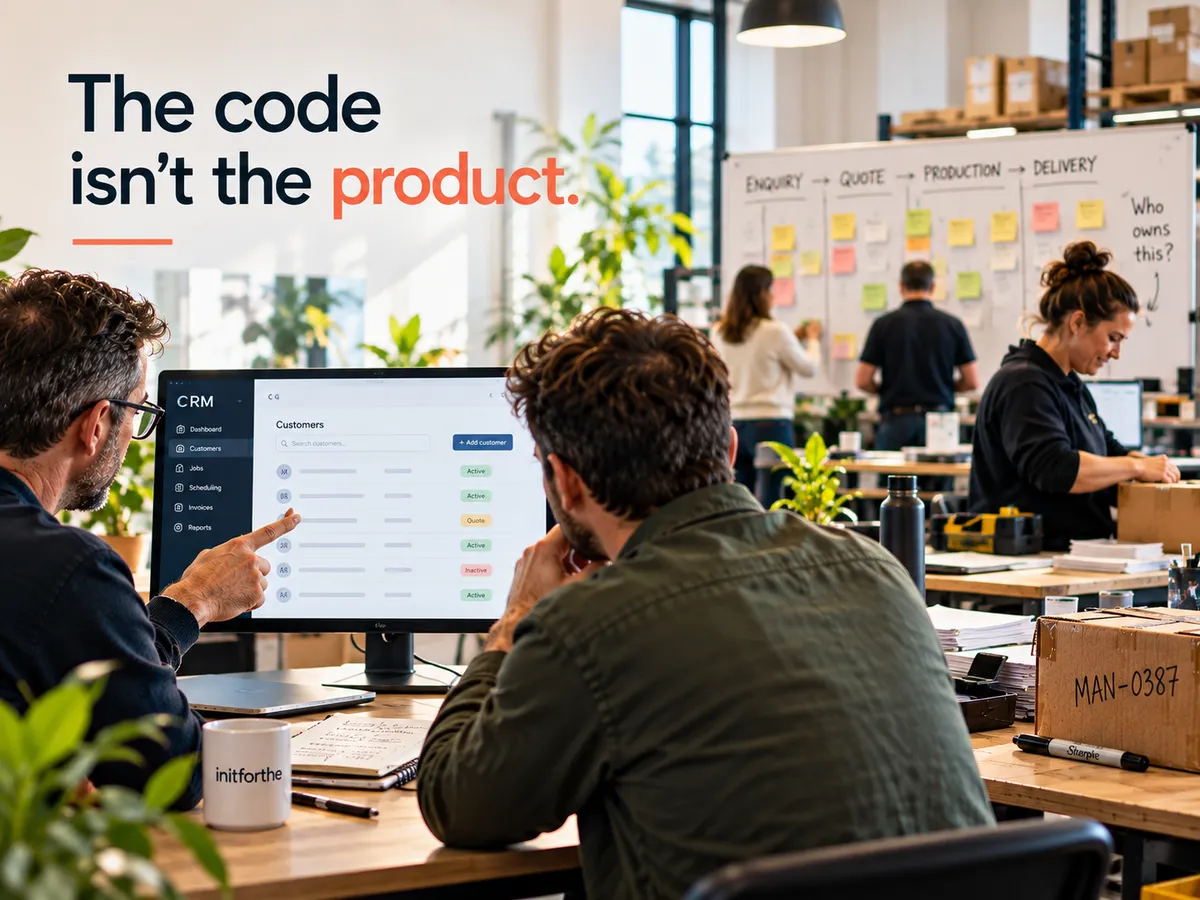
Tech
AI can write the code. Your business still needs an engineer
AI can now write a lot of the code we used to pay developers to write. That doesn’t make software engineering irrelevant. It makes the bit that was always more important much harder to ignore: understanding what should be built in the first place.
Vibe coding can turn your assumptions into working software incredibly quickly. But if the assumption is wrong, you’ve simply built the wrong thing faster. Good engineering starts before the app, CRM or automation. It starts by understanding how the business actually works, where people add judgement, and which parts of the process shouldn’t exist at all.
Tomislav Simnett
11 min read

Business
Four interruptions, two lost hours and the process your people shouldn’t be driving
Four interruptions can wipe nearly two hours from the useful part of a working day, and that’s before you count the interruption itself. Add long manual processes, routine human error, rework and stress, and you get a working environment where good people spend too much time recovering, correcting and chasing.
The answer isn’t to tell people to focus harder. It’s to design a better system, one that drives the process, preserves context, moves routine work automatically and only interrupts people when their judgement is genuinely needed.
Tomislav Simnett
10 min read

Business
The approval takes five minutes. The waiting costs far more.
A five-minute approval can leave work waiting for days. Once a quote, purchase, job or invoice misses its slot, the delay spreads into the rest of the process.
People switch tasks, schedules move, customers wait and cash arrives later. The decision itself may be quick, but the queue around it can cost far more than anyone realises.
Tomislav Simnett
9 min read