

Business
The approval takes five minutes. The waiting costs far more..

Tomislav Simnett
9 min read
Most approval processes start for a good reason.
A business grows, more people get involved, mistakes become more expensive, and managers want a bit more control. So quotes need signing off, purchases need authorising, changes need checking and certain decisions have to go through someone more senior.
None of that is inherently a problem. The problem starts when the business measures the approval itself, but ignores everything that waits around it.
A manager might only spend five minutes looking at a request, which sounds efficient enough; but if the request sits in their inbox for two days while three people stop, chase, switch tasks and come back to it later, the approval has cost far more than five minutes.
That’s the bit most businesses don’t measure.
The decision time isn’t the waiting time
There’s a big difference between how long a decision takes and how long the work is delayed by it.
Approving a quote might take five minutes, checking a purchase order might take two, and confirming a change could be a thirty-second reply.
But the work doesn’t experience the thirty seconds; it experiences the queue.
Say six people each lose 20 minutes a day because they’re waiting for a decision, checking whether it’s been made, finding the latest version, or picking the work back up after moving onto something else. That’s two hours a day, ten hours a week and roughly 500 hours a year.
At a loaded employment cost of £35 an hour, that’s £17,500 a year, and that’s only the immediate salary cost.
It still leaves out the delayed quote, the supplier slot that was missed, the job that couldn’t start, the invoice that wasn’t raised, and the customer who went with the business that replied first.
The approval may only take five minutes; the waiting can cost days.
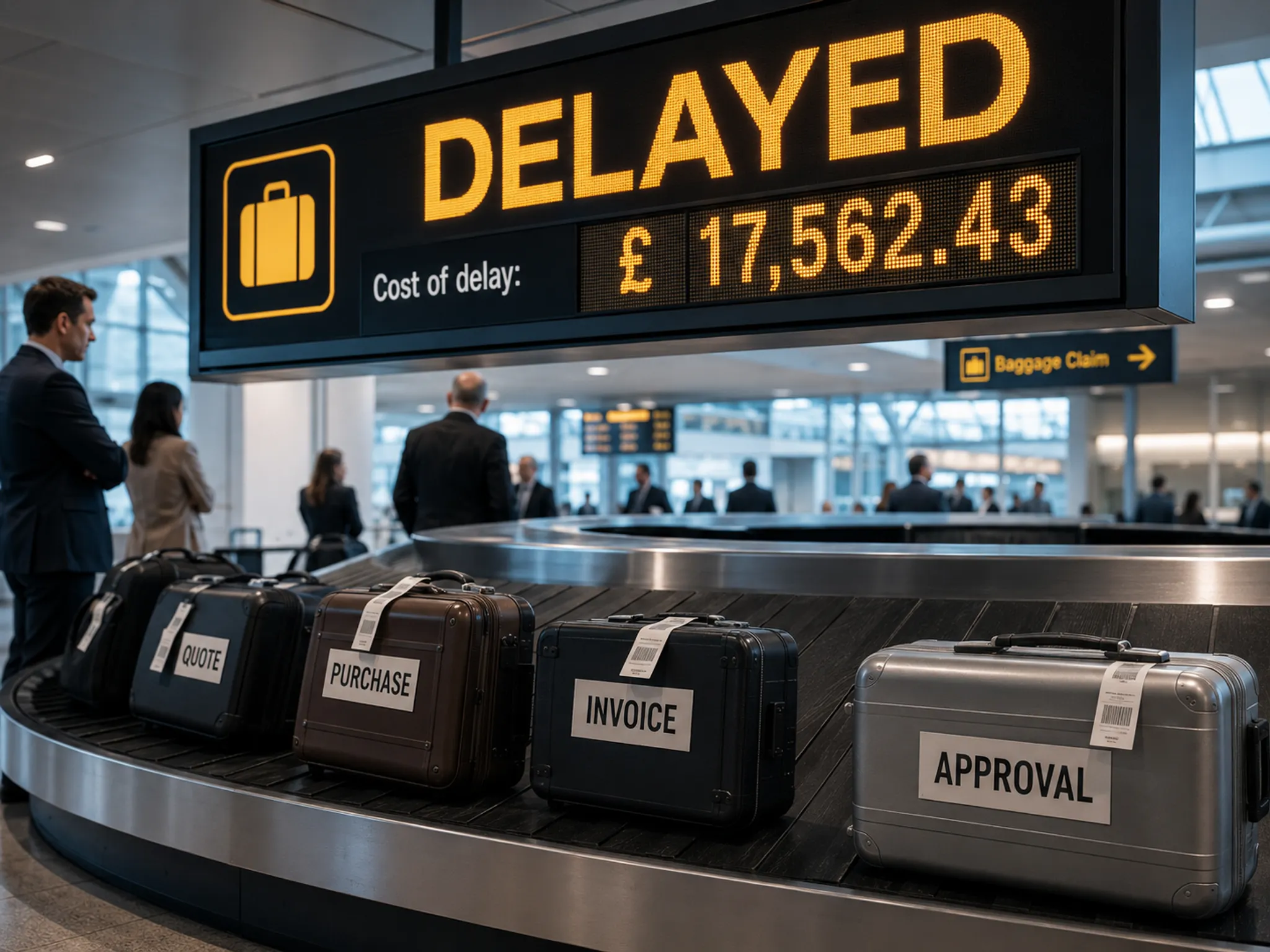
Approval delays work like missed airport slots
Think about a delayed flight.
The plane takes too long to load, the doors close late and it misses its take-off slot. On the face of it, the delay might only be 15 or 20 minutes, but that missed slot can affect everything that follows.
The aircraft may have to wait for another chance to leave, then arrive after its original landing slot. Once it gets there, the gate may no longer be available, the ground crew may be dealing with another flight, and the baggage carousel may already have been allocated elsewhere. Passengers miss connections, crews run out of time and the disruption carries on long after the original problem has been fixed.
The same thing happens inside a business.
A quote misses the moment when the customer was ready to decide. A purchase misses the supplier’s next delivery. A job misses its place in the schedule. An invoice misses the payment run.
The approval itself may only have been delayed for a few hours, but the work can end up sitting in several more queues afterwards.
That’s why waiting time compounds. You’re not just losing the time before the decision; you’re losing the next available slot in every part of the process that follows.
And just like an airport, the effect isn’t limited to one flight. Other work gets moved around to fill the gap, people switch priorities, schedules are reshuffled and customers are given new dates. By the time the original approval arrives, the business may no longer be ready to act on it.
The approval didn’t just delay the work; it made the work miss its slot.
Why approval processes grow
Approval processes usually expand gradually.
One mistake happens, so another check is added. A purchase goes over budget, so all purchases now need approval. A quote goes out with the wrong margin, so every quote is reviewed. Someone makes a poor decision, so everybody loses a bit of autonomy.
Each individual response feels sensible.
The trouble is that controls are rarely removed later, even when the team, the process or the business has changed; they just accumulate.
Before long, capable people need permission for decisions they’re perfectly able to make, managers are copied into things they don’t really need to see, and routine work keeps stopping in the same place.
The process has been designed around the possibility of something going wrong, rather than the likelihood of it. That creates a business where nearly every decision feels important enough to escalate, even though most of them are ordinary.
Managers become bottlenecks
This is one of the most common consequences: the manager becomes the person everybody is waiting for.
They’re asked to approve prices, purchases, changes, leave, refunds, wording, schedules, exceptions and sometimes things that aren’t really decisions at all. Their inbox becomes a queue, and the rest of the business slows down behind it.
The stupid thing is that this often gets mistaken for importance.
The manager looks indispensable because so much depends on them; in reality, they’ve become a bottleneck in a process that gives too little authority to everybody else.
That isn’t good for the team, and it isn’t good for the manager either. They spend their time checking routine work rather than solving difficult problems, developing people, improving the business or making the decisions that genuinely need their judgement.
A good approval process should protect the business. A poor one simply moves every decision upwards.
Waiting creates more work than it appears to
The cost isn’t only the time spent chasing, because people don’t usually sit still while they’re waiting; they switch to something else.
That sounds productive, but it creates another problem. When the decision finally comes back, they have to remember where they were, reopen the documents, find the latest information and rebuild the context.
A task that should’ve taken an hour might now be spread across three days and five interruptions. The actual work hasn’t changed, but the effort required to complete it has.
That context switching is hard to see because it doesn’t appear anywhere as a separate task. Nobody writes “reconstructed my train of thought after waiting for approval” on a timesheet, but it happens constantly.
A quote is half-finished, then paused. A purchasing decision is opened, checked and left. A customer issue is discussed, deferred and then revisited; each restart adds a bit more time and another chance for something to be missed.
The work becomes slower, not because people are working slowly, but because the process keeps forcing them to stop.
Over-control changes how people behave
There’s another cost too, and it isn’t just financial.
If people have to ask permission for every routine decision, they stop taking ownership. They become less confident, more cautious and more likely to escalate things they could’ve handled themselves.
That’s a rational response; if the system tells people they aren’t trusted to decide, they’ll wait for someone who is.
The manager then complains that the team doesn’t take enough initiative, while the process makes initiative difficult.
That creates a frustrating cycle. The team ask more questions, the manager becomes busier, approvals take longer, and everybody becomes even more reluctant to move without permission.
A well-designed business needs control, but it also needs people who can act within clear boundaries. The aim isn’t to remove oversight; it’s to make sure oversight is applied where it’s actually valuable.
Not every decision carries the same risk
This is where many approval processes go wrong.
A £500 purchase and a £50,000 purchase don’t carry the same risk. A standard discount and an unusual commercial concession aren’t the same thing. A routine customer refund and a legal dispute shouldn’t follow the same path.
But in a badly designed process, everything is treated as though it’s equally important.
That’s how managers end up approving hundreds of low-risk decisions while the genuinely important ones are buried in the same queue.
Better processes use thresholds, rules and exceptions. A purchase below an agreed amount can proceed automatically; a quote within an approved margin doesn’t need another pair of eyes; a standard refund can be handled by the customer service team.
Only the unusual, expensive or risky decisions are escalated.
That doesn’t reduce control; it improves it. Instead of managers looking at everything, they look at the things that actually need judgement.
The commercial cost is bigger than the admin cost
The easiest cost to calculate is the internal time, but approvals often affect the parts of the process closest to revenue and cash.
A quote waits, so the customer loses interest or chooses someone else. A purchase waits, so materials arrive late and the job misses its slot. A change waits, so the team carry on with the wrong information. An invoice waits, so cash arrives later. A customer waits, so confidence drops.
None of those losses appears under “approval process” in the accounts.
They show up as slower sales, lower capacity, weaker margin, more work in progress, more customer chasing and more pressure on the team.
That’s why the cost is so often underestimated. The business sees a five-minute managerial task; it doesn’t see the days of movement that didn’t happen behind it.
Good approval design doesn’t mean removing control
There’s a lazy version of this argument that says approvals are bad and people should just be allowed to get on with things.
That isn’t the point.
Some decisions absolutely need approval. Some carry financial, legal, reputational or operational risk, and it would be reckless to remove control completely.
The issue is whether the process distinguishes between routine work and genuine exceptions.
A good approval process should answer a few simple questions. What can people decide for themselves? What limits apply? What information must be present? What makes something unusual enough to escalate? Who is responsible for making the decision? How quickly does it need to happen? What happens if that person isn’t available?
Those questions create clarity.
Without them, the process usually becomes “ask the manager”, which is simple to design and expensive to operate.
Systems should move routine work and expose exceptions
This is where better operational design makes a real difference.
A well-designed system can check whether a request is within agreed limits, whether the required information is present, whether the margin is acceptable, whether the customer is within credit terms, or whether the purchase is inside budget.
If everything is normal, the work can move.
If something is unusual, the right person can be alerted with the information they need to make a proper decision.
That’s much better than sending every request into the same inbox and hoping someone notices.
Automation and AI can help here too, but only when the process is clear. They can flag unusual values, compare a request against policy, prepare the relevant context and route exceptions to the right person.
They shouldn’t be used to add another layer of complexity to a process nobody understands.
The aim is simple: routine work should keep moving, while genuine exceptions become easier to see.
Start by noticing the wait
Measuring waiting time properly is difficult because most businesses don’t record it. People don’t usually sit still with a stopwatch running; they switch tasks, send a chaser, pick up something else and come back later.
That means the delay disappears into the working day.
A quote is “with the director”. A purchase is “waiting for sign-off”. A job is “on hold until we hear back”. Everyone knows the work isn’t moving, but nobody necessarily sees that as a measurable part of the process.
It takes a bit of determination to find it, because you first have to realise that waiting is work too. Not productive work, obviously, but it still consumes attention, creates interruption and pushes everything else further back.
You don’t need perfect data to begin with. Start by looking for the signs: repeated chasing, work being reopened, people asking for updates, customers waiting for answers, managers becoming the final step in dozens of routine decisions, and tasks that seem to take days even though the actual work only takes an hour.
Then sample it.
Pick one approval-heavy process and follow ten real pieces of work through it. Note when each one was ready, when approval was requested, when the decision was made, how many times it was chased, and what had to be restarted afterwards.
The numbers will probably be rough, but they’ll be far more useful than assuming the approval only cost the five minutes it took to read.
Better systems manage the flow for you
This is where better systems make a real difference, because they don’t just hold the information; they manage what should happen next.
When a piece of work reaches an approval point, the system should know who owns the decision, what information they need, how long they’ve got, and what should happen if they don’t respond.
Routine requests can move automatically within agreed limits, while unusual or higher-risk decisions are routed to the right person with the relevant context already attached.
That removes a surprising amount of work. Nobody has to remember who to chase, search for the latest version, or work out whether the approval is still outstanding; the system can show that clearly, send reminders, escalate delays and keep a record of how long the work spent waiting.
It also solves part of the measurement problem.
Most businesses struggle to calculate waiting time because they’ve never captured it in the first place. A well-designed system records when the work was ready, when approval was requested, when the decision was made and what happened next, so the delay stops being a vague feeling and becomes something the business can actually see.
The point isn’t to turn every decision into a rigid workflow.
Good systems should handle the normal route and make the exceptions obvious; people still apply judgement, but they do it where judgement is genuinely needed rather than spending their day moving routine work through the business by hand.
That’s what managing flow properly looks like. The system keeps the work moving, highlights where it’s stuck and gives people the information they need to make the right decision quickly.
Without that, the process depends on memory, inboxes and persistence. With it, the business can see the queue, control the risk and stop good work disappearing into “waiting for approval”.
The decision may be quick, but the queue around it may be costing far more than anyone realises. Once you separate routine decisions from genuine exceptions, give people clear limits and make the work visible, you don’t just save a manager a few minutes; you release capacity across the whole process.
That’s the difference between having control and simply making everybody wait.
How much capacity is your business leaving behind?
Use the calculator to estimate what slow processes, manual work and disconnected systems could really be costing you.
More posts.
View all
Tech
AI can write the code. Your business still needs an engineer
AI can now write a lot of the code we used to pay developers to write. That doesn’t make software engineering irrelevant. It makes the bit that was always more important much harder to ignore: understanding what should be built in the first place.
Vibe coding can turn your assumptions into working software incredibly quickly. But if the assumption is wrong, you’ve simply built the wrong thing faster. Good engineering starts before the app, CRM or automation. It starts by understanding how the business actually works, where people add judgement, and which parts of the process shouldn’t exist at all.
Tomislav Simnett
11 min read

Business
Four interruptions, two lost hours and the process your people shouldn’t be driving
Four interruptions can wipe nearly two hours from the useful part of a working day, and that’s before you count the interruption itself. Add long manual processes, routine human error, rework and stress, and you get a working environment where good people spend too much time recovering, correcting and chasing.
The answer isn’t to tell people to focus harder. It’s to design a better system, one that drives the process, preserves context, moves routine work automatically and only interrupts people when their judgement is genuinely needed.
Tomislav Simnett
10 min read
Business
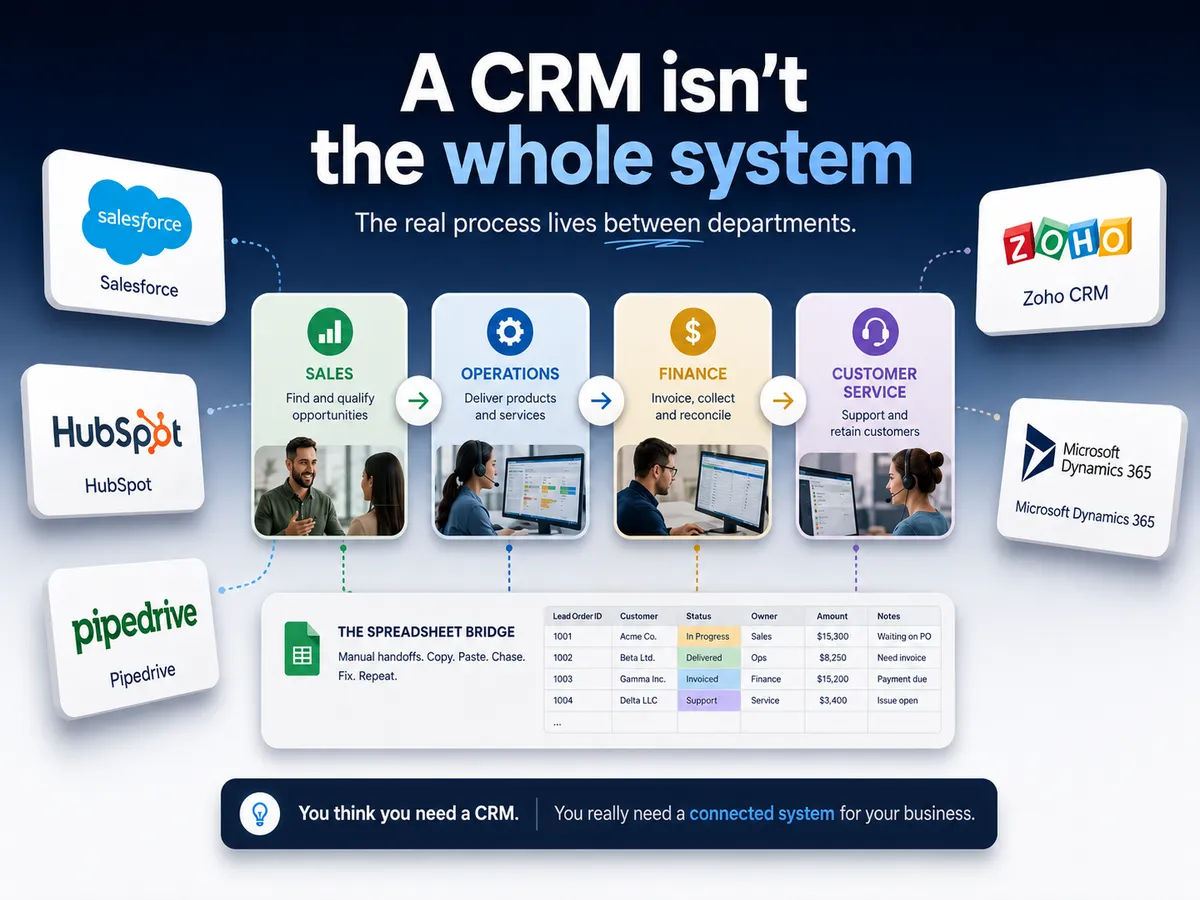
You probably don’t need a CRM; you need the work to flow properly.
Most growing businesses think they need a CRM, but the real problem usually sits between departments.
When sales, operations and finance all rely on different systems, spreadsheets and good people end up holding the process together by hand.
When sales, operations and finance all rely on different systems, spreadsheets and good people end up holding the process together by hand.
Tomislav Simnett
6 min read