

Business
You probably don’t need a CRM; you need the work to flow properly..

Tomislav Simnett
6 min read
Most growing businesses think they need a CRM, not because they’ve carefully mapped the business process and concluded that customer relationship management software is the missing part, but because "CRM" has become the word people use for a system that’s supposed to make the business work better.
That’s how the market sells it. The CRM is going to give you visibility, become the source of truth, automate follow-ups, improve communication, produce better reports and stop things being missed; so the business buys one, sales start using it, marketing might use it, customer service may get pulled into it as well, and pipelines and dashboards begin to appear.
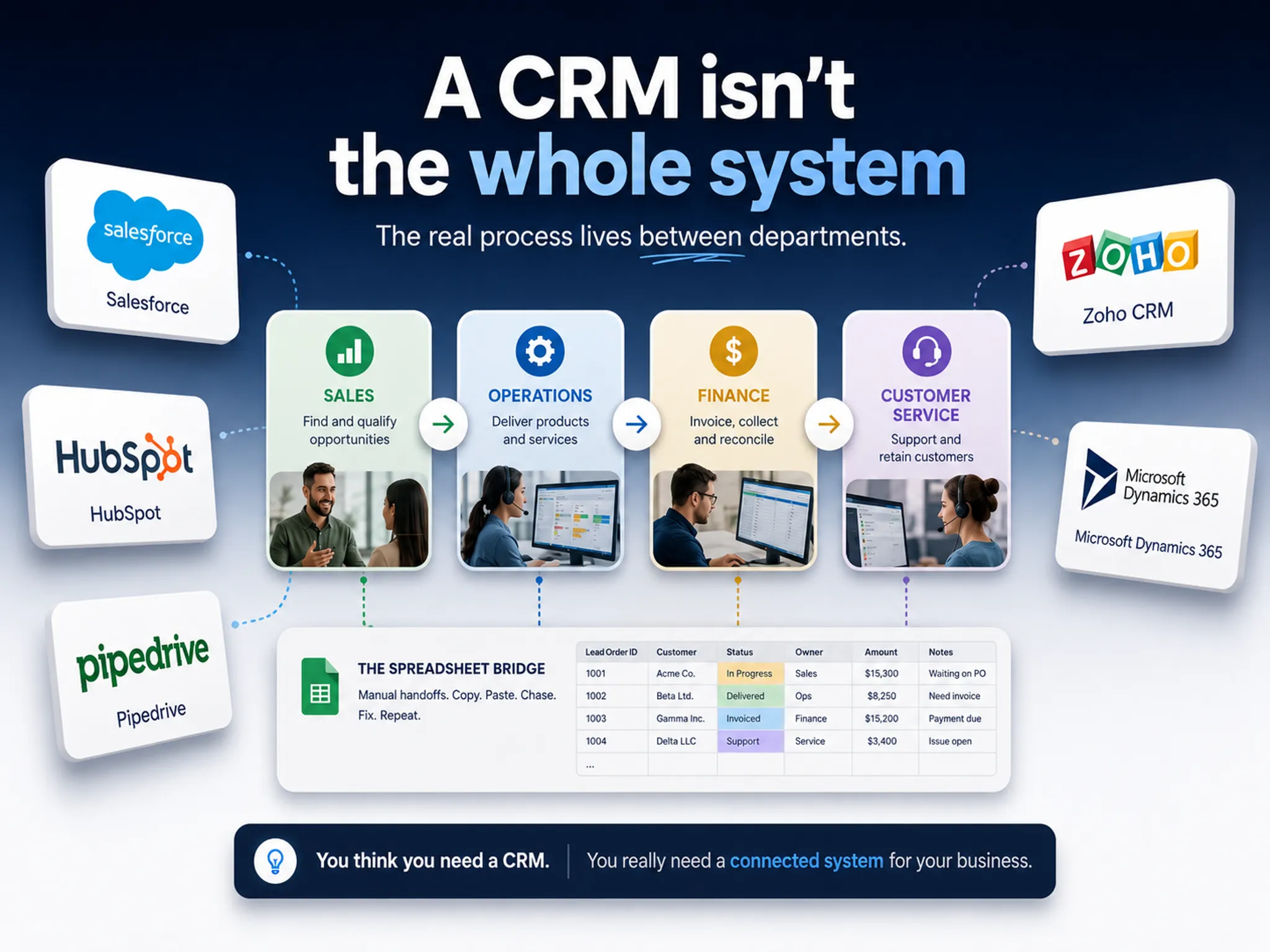
Then someone creates a spreadsheet, because the CRM doesn’t hold what operations need, finance can’t see when the work’s finished, and somebody has to pull the whole process together somehow.
Sales need to pass something to operations, but operations need more information than the CRM holds; finance need to know when the work’s been completed, but that information is sitting somewhere else; customer service need to answer a question, but the answer depends on checking the CRM, the job system, an email trail and what someone remembers from an earlier conversation.
So somebody exports the information, adds a few columns, puts in some colours and creates a file that everyone gradually becomes dependent on. The CRM still "works brilliantly", and so does the finance system and the operations platform - they just don’t work brilliantly together.
The business doesn’t run in departments
Businesses need departments because people need clear responsibilities; sales sell, operations deliver and finance invoice, which all makes sense. The problem is that the work itself doesn’t respect those boundaries.
A customer agrees to buy something, that sale needs to turn into work, and the work needs to be planned, priced, scheduled, delivered and checked; changes need to be approved, costs need to be captured, the customer needs to be kept informed, and when the work’s finished, finance need to know they can invoice it.
That’s one process - the departments are simply the people involved at different points.
The most complex parts usually aren’t inside sales, finance or operations; they sit between them, in the handovers and conversations. What exactly did sales promise? Has operations got everything they need? Was that change included in the price? Has the customer approved it? Are we waiting for materials? Can finance invoice this yet? Who owns the next step?
That’s where work slows down, and it’s also where most off-the-shelf systems become less useful, because they’re usually sold into a department. The CRM is built around sales, the finance platform is built around accounts, and the operations software is built around delivery.
Each one may be perfectly good at its own job, but the business doesn’t need three good departmental systems; it needs the whole process to work. When that process hasn’t been designed properly, people fill the gaps themselves - usually with spreadsheets, emails, meetings and memory.
The spreadsheet isn’t the problem
I’m not anti-spreadsheet; spreadsheets are brilliant, they’re quick, flexible and useful for analysis, and the fact that one exists doesn’t automatically mean something needs replacing.
But when the business can’t operate without one, it’s worth asking why. What systems does it sit between? Who updates it? What information gets copied into it? Who checks it? What happens if it isn’t updated, and which decisions depend on it?
The spreadsheet often shows you exactly where the bought systems stop supporting the business. It might be adding information the CRM doesn’t hold, translating sales data into something operations can use, or providing the only view that shows whether a job is sold, scheduled, delivered and ready to invoice.
That makes the spreadsheet useful, but it also makes it evidence - it’s showing you the part of the system the business has had to build for itself. The issue isn’t Excel; the issue is paying people to keep that missing part alive manually.
The spreadsheet is free. Keeping it alive isn’t.
Say five people each spend 15 minutes a day updating, checking or correcting the same spreadsheet; that’s 75 minutes a day, more than six hours a week and over 300 hours a year. At a loaded employment cost of £35 an hour, that’s more than £10,000 a year - and that’s only the immediate salaried cost.
That still leaves out the manager checking whether it’s current, the meeting where everyone works through it, the duplicated information, the old version someone accidentally used, and the customer waiting while somebody tries to work out what’s happening. The spreadsheet maintenance is often the cheapest part of the problem; the bigger cost is usually all the waiting, chasing and rework around it.
A quote waits because a price hasn’t come back, a job waits because a question hasn’t been answered, an invoice waits because finance don’t know the work is complete, and a customer waits because the information needed to answer them is spread across four places. Those delays affect capacity, cash, margin and trust, but because the cost is spread across several people and departments, it rarely appears anywhere as one clear problem - it’s simply buried in salaries and accepted as part of the job.
And this is where the £10,000 starts to look almost irrelevant. Once you look beyond the spreadsheet and remove the same friction across the whole process, you’re not just saving a few hours of admin; you can release enough capacity for the same team to handle twice or three times the work without blinking. That’s the difference between trimming a cost and changing the economics of the business.
Most businesses carry this because it sort of works. Someone knows which column needs updating, someone remembers who to chase, and someone spots when the numbers don’t look right; the team compensate, the work gets done and the business grows around the weakness - until, eventually, everyone is flat out.
Good people become the integration
When the systems don’t join the process together, people do it. They copy the information, chase the update, check the totals, translate what sales meant into something operations can actually deliver, and remember which customer has an exception that was never recorded properly.
Those people are often described as invaluable, and they are; but partly because the business has built itself around what they carry in their heads, which isn’t a great use of good people.
You want capable people making judgements, solving problems, helping customers and improving the business; you don’t want them spending a chunk of every day acting as the connection between one piece of software and another.
It also creates risk. When they’re busy, everything slows down; when they’re off, questions pile up; when they leave, the business suddenly discovers that the process was never really in the systems at all - it was in them.
Growth makes the problem worse because more sales create more handovers, and more handovers create more checking, more chasing and more chances for something to be missed; at some point, the answer becomes another hire.
Sometimes the business genuinely needs another person. Quite often, though, it’s hiring someone to operate the gap; the new person updates the spreadsheet, prepares the report, chases the missing information and makes sure the departments stay aligned.
The business has added salary around the inefficiency. Revenue grows, but margin doesn’t improve because every increase in work creates a matching increase in admin and coordination - that isn’t leverage, it’s just a bigger version of the same process.
Buying a CRM isn’t the same as designing a system
A CRM may be part of the answer, and it may be a very important part; but it isn’t automatically the system for the whole business just because the provider has described it that way.
The better question isn’t, “Which CRM should we buy?” It’s, “How does the work actually move through this business?”
Where does it start, what information gets created, who needs it next, where does it wait, what gets copied, what do people keep chasing, which decisions rely on someone remembering something, and what happens when a job doesn’t follow the normal route?
Once you understand that, you can decide what the business actually needs. Some of it may already be covered perfectly well by the systems you have; some of it may need integrating, some may need automating, and some may be important enough to build and own.
We work through the business properly: what needs to be controlled, what should be bought, what should be integrated, what should be automated, and what’s important enough to own.
That doesn’t mean replacing everything; in most businesses, that would be disruptive, expensive and unnecessary. A good change project might leave the CRM exactly where it is, leave finance alone and only change the handover between sales and operations.
It might remove one spreadsheet, automate one repeated task or create one view that shows the whole process properly; small changes in the right place can alter the trajectory of the business.
The point isn’t to give every department a better tool - it’s to make sure the work flows through the whole business without relying on good people to keep stitching the gaps together by hand.
So yes, you may need a CRM; but if the output still has to be copied into a spreadsheet before the rest of the business can use it, you haven’t bought the system. You’ve bought one part of it, and you’re paying the team to build the rest every day.
How much capacity is your business leaving behind?
Use the calculator to estimate what slow processes, manual work and disconnected systems could really be costing you.
More posts.
View all
Business
Your Software Holds the Data. But Does It Know How Your Business Works?
Your software might hold all the data about your business, but does it actually know how your business works? In two recent conversations, I challenged business leaders to question something they'd always taken for granted: whether the work their people were doing needed a person to do it at all.
From unnecessary CRM administration to an entire department dependent on one employee's knowledge, both conversations revealed opportunities that went far beyond making existing tasks easier. What if our systems could understand how work happens, learn from our best people and eventually take responsibility for much of the routine work themselves?
Tomislav Simnett
8 min read
Tech
AI can write the code. Your business still needs an engineer
AI can now write a lot of the code we used to pay developers to write. That doesn’t make software engineering irrelevant. It makes the bit that was always more important much harder to ignore: understanding what should be built in the first place.
Vibe coding can turn your assumptions into working software incredibly quickly. But if the assumption is wrong, you’ve simply built the wrong thing faster. Good engineering starts before the app, CRM or automation. It starts by understanding how the business actually works, where people add judgement, and which parts of the process shouldn’t exist at all.
Tomislav Simnett
11 min read

Business
Four interruptions, two lost hours and the process your people shouldn’t be driving
Four interruptions can wipe nearly two hours from the useful part of a working day, and that’s before you count the interruption itself. Add long manual processes, routine human error, rework and stress, and you get a working environment where good people spend too much time recovering, correcting and chasing.
The answer isn’t to tell people to focus harder. It’s to design a better system, one that drives the process, preserves context, moves routine work automatically and only interrupts people when their judgement is genuinely needed.
Tomislav Simnett
10 min read