

Business
Why software procurement might be costing your business more than it's saving.

8 min read
A number of years ago, a business came to us because the vendor of its existing software was shutting the system down. They needed a replacement and wanted us to rebuild what they already had.
We said no. Instead, we offered to fix how they worked.
That business has since told us that the work we've done together has enabled them to avoid recruiting an additional 140 people, representing close to £10 million a year in staffing costs. They haven't achieved that by reducing their workforce. They've achieved it by growing their business without needing to grow their workforce at the same rate.
More recently, a manufacturer approached us looking for a warehouse management system. They'd identified that the inventory management functionality within Zoho couldn't cater for their needs and had quite reasonably concluded that they needed something more specialist.
But a warehouse management system wasn't what they needed, at least not initially. By spending time understanding how their team worked, we identified a much more immediate opportunity to improve their goods-in process. The resulting changes increased throughput by 50%. Even when we subsequently started looking at warehouse management, what the business needed was quite different from how conventional warehouse management systems are designed.
What's interesting about both of these examples is that, had we been responding to a conventional procurement exercise, there's a reasonable chance we wouldn't have made the shortlist.
In neither case were we proposing to deliver what the business had asked for.
What if you're procuring the wrong thing?
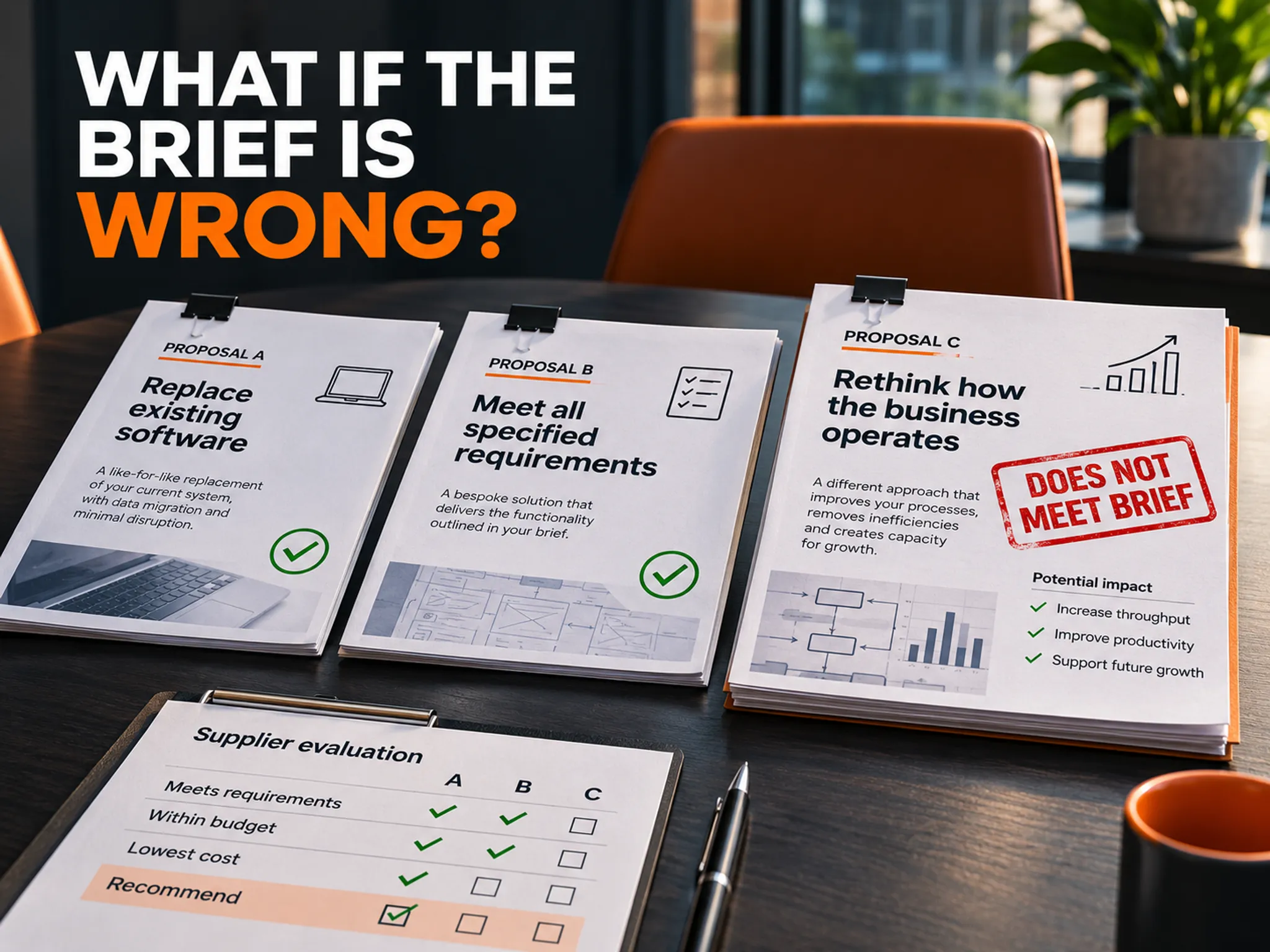
The conventional procurement process relies on a fairly significant assumption: that the business already knows what it needs.
Someone identifies a problem, determines what they believe the solution to be, puts together a set of requirements and invites suppliers to demonstrate how they can meet them. Those suppliers are then assessed against various criteria, including functionality, experience, delivery timescales and, of course, cost.
It's a perfectly sensible approach when you know exactly what you're buying. If you need 200 laptops with a particular specification, finding the most commercially advantageous way of acquiring them makes complete sense.
But what happens when the greatest value a supplier can bring to your business lies in challenging what you're asking for?
In the case of the manufacturer, the inability of Zoho to meet their inventory management requirements was a genuine problem. However, one of the biggest opportunities we identified was in how deliveries were being received and processed.
An employee was repeatedly having to go up and down the stairs between the warehouse and the office to complete the work. Identifying discrepancies with deliveries could take long enough that the delivery vehicle had already left.
That work can now be completed in less than ten minutes, with discrepancies identified whilst the delivery vehicle is still there.
Would a conventional warehouse management system have solved that problem? Possibly. But would the business have known to assess prospective systems against that particular opportunity? And would a supplier have been given the opportunity to question whether a warehouse management system was the right starting point?
There's a considerable difference between identifying a problem and identifying the right solution to it. A procurement process that begins after the solution has already been decided risks missing that distinction altogether.
You can't compare apples and pears
Imagine a business looking to invest in technology to improve its operational efficiency. It approaches three suppliers.
The first proposes an established software product that broadly meets the requirements, with some customisation to accommodate the business's specific needs.
The second proposes building bespoke software that supports the way the business currently operates.
The third questions why the business operates the way it does in the first place and proposes a fundamentally different approach.
How do you meaningfully compare those three proposals?
You could compare their costs, their delivery timescales and the functionality they'd provide. What you'd struggle to compare is what the business would subsequently be capable of achieving as a result of each engagement.
Even something as seemingly straightforward as comparing consultancy rates tells you remarkably little. A more expensive consultant might identify that half of what you're proposing to build is completely unnecessary. Their greatest contribution could be the work they persuade you not to commission.
There's nothing wrong with any of the three approaches. Depending on the circumstances, any one of them could be the right answer. The difficulty comes when we try to make fundamentally different approaches comparable by assessing them against the same predetermined requirements.
In doing so, we risk eliminating the very differences that could provide the greatest value to the business.
Are procurement savings really savings?
Imagine a procurement team successfully negotiating a £20,000 reduction in the cost of a software development engagement. That's a tangible, measurable saving that can be reported back to the business.
Now imagine that, in the process of selecting and negotiating with suppliers, the business overlooks an opportunity to reduce its annual operating costs by £1 million.
Where does that appear in the procurement team's performance figures?
It almost certainly doesn't, because nobody necessarily knows that the opportunity existed.
This is one of the difficulties with measuring the success of procurement against purchasing savings. It's relatively easy to measure the difference between an original quotation and the amount eventually paid. It's considerably harder to measure the value of opportunities that were never explored.
Consider the business we mentioned earlier. Had it engaged us simply to rebuild its existing system, it might have ended up with a perfectly capable replacement. A procurement team might even have negotiated an excellent price for it.
But the business would still have been operating in fundamentally the same way.
The difference between those two outcomes isn't a percentage saving on the cost of software development. It's a business that has been able to accommodate growth without needing to find, recruit, train, manage and pay another 140 people.
When considered in that context, how much significance should the original cost of the software have in the investment decision?
You should want your technology partners to be profitable
There's another aspect of conventional procurement that we think deserves considerably more attention, particularly when businesses are establishing long-term strategic relationships with technology partners.
Why wouldn't you want your technology partner to be commercially successful?
When you work with a software consultancy over a number of years, that consultancy develops an increasingly detailed understanding of your business. Its people understand your operations, your commercial objectives, your challenges and the reasons behind decisions that might have been made several years earlier.
That accumulated knowledge becomes enormously valuable. It allows the consultancy to identify opportunities that might otherwise go unnoticed and to respond more effectively as your business evolves.
Maintaining that capability costs money. Consultancies need to attract and retain good people, invest in their own expertise, maintain high standards of security and continually develop their capabilities. They also need to be financially sustainable.
All of those things are in their clients' interests.
Yet businesses will frequently identify a technology partner they believe can help them achieve their long-term ambitions, before handing the relationship over to a procurement team whose objective is to reduce the amount that partner earns.
Of course, businesses shouldn't accept unreasonable pricing, and a consultancy should be able to justify the investment it's asking a client to make. But there's a difference between establishing whether an investment represents good value and simply trying to secure the same service for less money.
If a reduction in price compromises the supplier's ability to invest in its people, retain expertise or continue providing the level of service the client depends on, the client bears some of the consequences too.
At what point does reducing the profitability of a strategic partner start increasing the risk to your own business?
A successful long-term relationship should enable both businesses to grow. If the work a consultancy delivers continues to generate a substantial return for its client, the commercial success of that consultancy shouldn't be seen as something that needs to be curtailed.
Where does procurement fit into business transformation?
None of this means that businesses should abandon commercial scrutiny when investing in technology. Understanding contractual commitments, establishing appropriate protections, assessing supplier viability and ensuring transparency around costs are all important.
Procurement teams can contribute valuable expertise in these areas, particularly within larger organisations.
However, there's a distinction between helping a business make a responsible investment and determining whether that investment should be made, with whom, and on what basis.
We'd argue that decisions about technology that fundamentally changes how a business operates should be owned by the people responsible for the performance and growth of that business.
Those people need to be involved in understanding the problems, exploring the opportunities and establishing whether the potential returns justify the investment. They also need to remain accountable for whether those returns are subsequently realised.
A procurement team can help establish a commercial framework that protects both parties and allows the relationship to develop. It can challenge unclear financial commitments, ensure the business retains appropriate ownership of its data and technology, and help manage the risks associated with a long-term dependency.
But if its success is ultimately measured against how much money it can prevent the business from spending, there's an inherent tension between its objectives and those of a technology partner looking for opportunities to help the business grow through further investment.
That's a tension for leadership to resolve.
What should businesses do differently?
Rather than starting with a specification for a piece of software, we'd encourage businesses to start with a conversation about what they want to achieve.
Perhaps you want to double your turnover without doubling your headcount. Perhaps your employees are spending so much time administering work that they're struggling to deliver the service your customers expect. Perhaps the systems that supported your business when it was half its current size are now restricting its ability to grow.
These are business problems. Whether they require new software, changes to existing software, better integration between systems or simply a different way of working should still be open to discussion.
When selecting a technology partner, look at the outcomes they've achieved for other businesses. Understand how they approach problems, how they work with people and whether they're prepared to challenge your assumptions. Ask them about occasions when they've advised a client against spending money on something.
Then invest in understanding your business properly before committing to a particular solution.
That initial investment doesn't need to be particularly substantial, nor does it need to commit you to a much larger engagement. It should give you enough insight to make a more informed decision about where further investment will deliver the greatest return. You're then able to make progressive investment decisions as your understanding develops and the benefits become clearer.
This also provides a more meaningful way to manage commercial risk than attempting to define, price and contract for an entire transformation before either party fully understands what it could involve.
What opportunities is your procurement process preventing you from discovering?
When we look back at some of the most significant improvements we've helped businesses achieve over the past two decades, many of them started with a conversation in which we challenged what we'd been asked to do.
That's not because the businesses we work with don't understand their own operations. They understand them extremely well. But when you've worked a particular way for many years, it's understandably difficult to envisage how differently things could work.
Bringing an experienced technology partner into that conversation gives you an opportunity to explore what's possible, rather than simply finding a more efficient way of doing what you already do.
The software itself is only part of the investment. Much of the value lies in the experience, judgement and understanding that determine what gets built, how it works and, perhaps most importantly, what doesn't need to be built at all.
If you're considering a significant investment in technology, it's worth looking at your own procurement process and asking whether it genuinely accommodates that kind of thinking.
Because if the most valuable thing a technology partner can do is challenge your requirements, why would you select that partner based on their ability to meet them?
The greatest cost of your procurement process might not be what you end up spending. It might be what you never discover your business could achieve.
About Tomislav Simnett

Tomislav Simnett
Managing Director, Initforthe · Software & AI Consultant
Tomislav helps businesses work better through bespoke software development, AI consultancy, CRM systems and automation. He founded Initforthe in 2004 and believes technology should make work easier for the people using it.
How much capacity is your business leaving behind?
Use the calculator to estimate what slow processes, manual work and disconnected systems could really be costing you.
More posts.
View all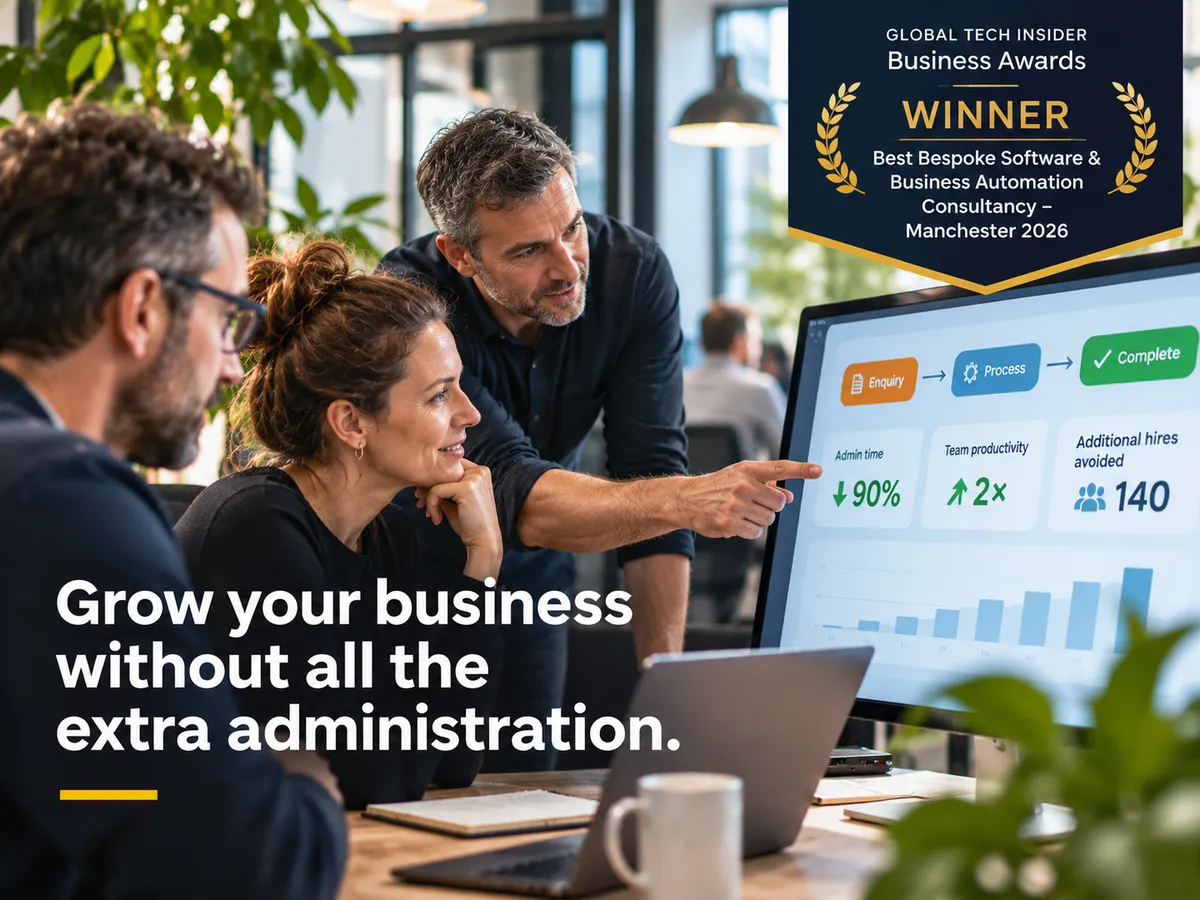
Business
What if your business could grow without all the extra administration?
We've been named Best Bespoke Software & Business Automation Consultancy – Manchester 2026 by Global Tech Insider. But the real story is what better systems can achieve: less administration, greater productivity and businesses able to grow without increasing their workforce at the same rate. One client estimates our work has saved them the need to employ 140 additional people, worth almost £10 million a year.
Tomislav Simnett
3 min read
Business
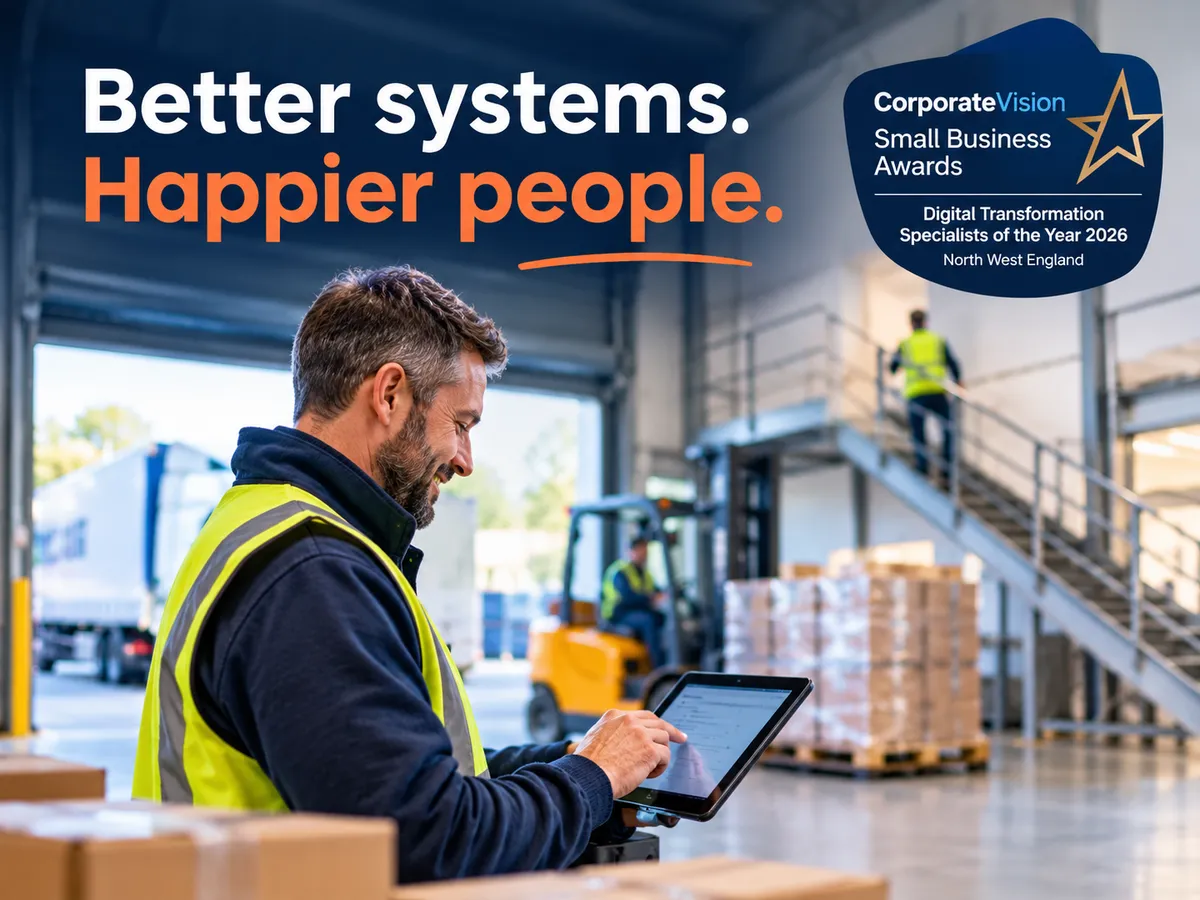
We've won a digital transformation award. Here's what really matters to us.
We've been named Digital Transformation Specialists of the Year 2026 – North West England. It's lovely recognition, but what matters more is the difference behind it: less paperwork, fewer frustrating processes and businesses able to grow without asking their people to work harder. That's what good technology should achieve.
Tomislav Simnett
4 min read

Business
Your Software Holds the Data. But Does It Know How Your Business Works?
Your software might hold all the data about your business, but does it actually know how your business works? In two recent conversations, I challenged business leaders to question something they'd always taken for granted: whether the work their people were doing needed a person to do it at all.
From unnecessary CRM administration to an entire department dependent on one employee's knowledge, both conversations revealed opportunities that went far beyond making existing tasks easier. What if our systems could understand how work happens, learn from our best people and eventually take responsibility for much of the routine work themselves?
Tomislav Simnett
8 min read